
Companion Plants
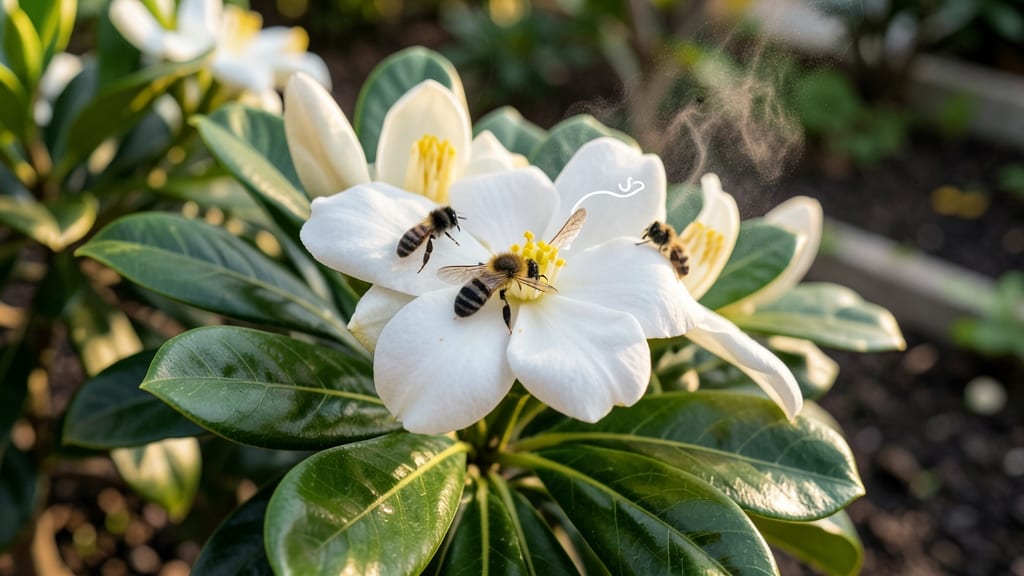
Gardenias rarely attract bees because their heavy, sweet fragrance and nectar are primarily designed to lure night-flying moths, not pollinators like bees. Their small, shallow flowers also lack the structure bees prefer for feeding.
Gardenias evolved to thrive in the nighttime ecosystem, releasing their strongest scents after sunset when moths are most active. 🌙 The deep, tubular shape of their flowers makes them perfect for moths with long proboscises, while the shallow nectar pools deter bees that need accessible feeding platforms.
This adaptation explains why you’ll rarely see bees buzzing around gardenias—even though their perfume might make you think otherwise!
If you’re looking to create a pollinator-friendly garden, consider plants like jasmine or honeysuckle, which produce abundant nectar and open their blooms during the day. These alternatives not only support local bee populations but also offer similar fragrant charm to gardenias.
The key is choosing plants that align with the pollinators you want to attract!
💡 In This Article
- Why Gardenias Are Moth Pollinators, Not Bee Magnets
- Best Bee-Friendly Alternatives to Gardenias for Your Garden
Why gardenias are moth pollinators, not bee magnets
The secret lies in gardenias' nocturnal scent chemistry. These flowers release their most potent fragrance between 8 PM and midnight, perfectly timed when moths are active.
Their scent molecules—like jasmine ketone and benzyl acetate—are heavier than bee-attracting floral compounds, lingering in the air like a moth's dinner bell. 🌙 Unlike daytime flowers that emit lighter, volatile compounds bees detect, gardenia aromas are designed to travel farther at night, guiding moths through the dark.
The flower's tubular shape (1-2 inches deep) is another key factor. Moths have long proboscises (up to 4 inches) that can reach deep into these flowers to access nectar, while bees typically prefer shallow, open blooms.
Gardenias produce nectar in deep, narrow pools> that require precise positioning—something bees struggle with. Compare this to lavender, whose flat, open flowers expose nectar freely at 1/4-inch depth, making it ideal for bee access.
Even the nectar composition> differs significantly. Gardenia nectar contains higher concentrations of sugars (20-30% sucrose) that moths metabolize efficiently, while bees prefer a 15-20% sucrose balance with specific amino acids.
The thick, syrupy consistency of gardenia nectar also makes it harder for bees to collect efficiently. 🐝 This evolutionary mismatch explains why you'll spot hawk moths (like the white-lined sphinx) visiting gardenias at dusk, but rarely see bees.
Color plays a subtle but crucial role too. While gardenias are white (highly visible to moths' UV-sensitive eyes), their UV-reflective patterns create guides invisible to human eyes but perfect for nocturnal pollinators.
Bee-friendly flowers often feature bright UV markings—like the yellow centers of sunflowers>—that create landing platforms. Gardenias lack these visual cues, making them functionally invisible to bees during daylight hours.
Consider this comparison: A sunflower produces 1,000-2,000 flowers per plant, each with accessible nectar, while a gardenia bush typically has only 50-100 flowers at peak bloom.
The sheer volume of bee-friendly blooms creates a "pollinator magnet" effect that gardenias simply can't match. 🌻 This structural difference explains why gardenias support moth populations but fail to attract bees—even when planted in pollinator-friendly gardens.
The takeaway? Gardenias represent a specialized nocturnal adaptation> that prioritizes moth pollination over bee visitation. Their evolution reflects a co-evolutionary arms race> between plants and their primary pollinators, where every floral trait—from scent timing to nectar depth—serves a specific ecological purpose.
For bee gardeners, this means understanding these botanical tradeoffs helps select plants that truly support local pollinator communities.