
Light Requirements
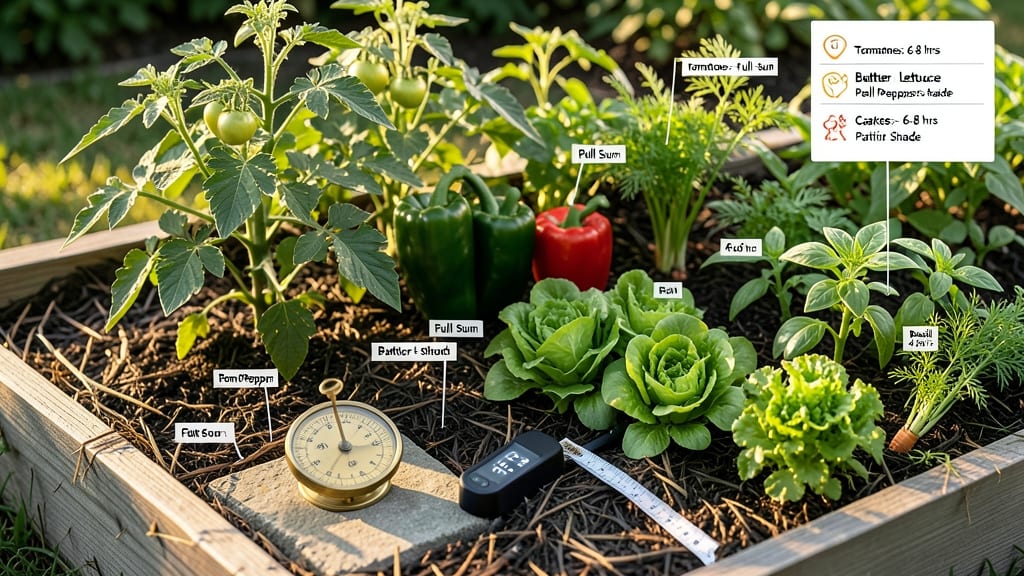
To get the right sun for your vegetable garden 🥬, aim for 6 to 8 hours of direct sunlight daily—most crops need this much to thrive, but some tolerate less.
Struggling to decide where to plant your tomatoes or lettuce? Sunlight requirements for vegetables vary wildly—some thrive in full sun while others bolt in the slightest heat.
Too little sun and your peppers won’t ripen; too much, and your leafy greens turn bitter. The key is matching each plant’s needs to your garden’s light conditions, whether you’re in a sunny backyard or a shady corner.
Below, I’ll break down the exact sun exposure your garden needs to maximize yields, avoid wasted effort, and keep your harvests productive all season long.

Sunlight requirements for vegetables: full sun vs partial shade explained
Understanding sunlight requirements for vegetables is the first step to a thriving garden. Photosynthesis drives growth, but too much or too little sun can stress plants. Full sun means 6-8+ hours of direct sunlight daily, while partial shade offers 3-6 hours.
Some vegetables, like tomatoes, crave full sun, while leafy greens tolerate partial shade. Heat tolerance varies too—some plants wilt in afternoon sun, while others thrive.
Sunlight isn’t just about hours—it’s about intensity and duration. High-desert gardens need protection from intense midday rays, while coastal areas benefit from gentle morning sun. Heat tolerance thresholds also matter: Peppers and cucumbers struggle in temperatures above 90°F (32°C), while kale and carrots handle cooler conditions.
Let’s break it down so you can place every plant perfectly.
Why sunlight matters: Plants convert light into energy through chlorophyll, but overheating can scorch leaves or cause bolting (premature flowering). Partial shade protects delicate crops, while full sun boosts fruit production in tomatoes and peppers. Even soil temperature plays a role—cool roots need shade, while warm roots thrive in sun.
Common mistakes: Many gardeners assume "sunny" means full sun, but afternoon shade can save heat-sensitive plants. Others overcrowd shade-loving crops, reducing airflow and increasing disease risk. Test your garden first: Use a sun calculator or observe shadows from 10 AM to 4 PM to map your space accurately.
| Sunlight Category | Definition | Best For | Risks of Mismatch |
|---|---|---|---|
| Full Sun (6-8+ hrs) | Direct sunlight all day; minimal shade. | Tomatoes, Peppers, Cucumbers, Corn, Squash | Leaf scorch, poor fruiting, bolting |
| Partial Sun (3-6 hrs) | Morning sun + afternoon shade or vice versa. | Leafy Greens, Beets, Carrots, Radishes, Lettuce | Leggy growth, bitter taste, low yield |
| Partial Shade (3-6 hrs, filtered) | Dappled or indirect light (e.g., under trees). | Spinach, Kale, Swiss Chard, Green Onions | Stunted growth, pale leaves, weak stems |
| Full Shade (<3 hrs) | Minimal direct light; mostly shade. | Mushrooms, Microgreens, Some Herbs (e.g., Cilantro) | Leggy, weak plants; poor harvests |
Not all sunlight hours are equal. Morning sun (cooler) is gentler than afternoon sun (hotter). Heat-sensitive plants like basil or beans may need afternoon shade in hot climates.
Use reflective mulch or light-colored containers to reduce heat stress. For container gardens, move pots to follow the sun’s arc if possible.
Climate adjustments: In Zone 10 (tropical), even partial shade can be too much for some crops. In Zone 4row covers to capture winter sun. High-altitude gardens (e.g., Denver) need more sun hours due to lower UV intensity. Always check USDA Zone guidelines and local microclimates.
Soil temperature ties to sunlight—warm soil speeds germination, while cool soil slows it. Black plastic mulch absorbs heat for sun-loving crops, while straw mulch keeps roots cool for shade-tolerant plants. Test your soil with a thermometer: Peppers need 70°F+ (21°C+), while lettuce thrives at 60-65°F (15-18°C).
If your garden has uneven sunlight, prioritize high-value crops in sunnier spots. Companion planting can help: Tall corn shades radishes below, while bush beans tolerate partial shade cast by tomatoes. Vertical gardening maximizes space for shade-loving plants like bush beans or green onions near fences or trellises.
Remember: Observation is key. Track plant performance for a season—note which crops thrive and which struggle. Adjust next year by rotating crops or adding shade cloth (30-50% coverage) as needed. With the right sunlight balance, your vegetable garden will reward you with bountiful harvests all season long.
Exact sun hours needed for top 15 vegetable plants (ranked by need)
Not all vegetables need the same amount of sunlight—some thrive in full sun while others bolt or wilt in too much heat. Understanding these sunlight requirements ensures your garden produces the best yields.
Below, I’ve ranked the top 15 vegetables by their sun needs, from the most demanding to the most shade-tolerant, including seasonal adjustments for winter vs. summer.
For example, tomatoes and peppers need 6-8+ hours of direct sunlight daily, while spinach and lettuce can tolerate as little as 3-4 hours. In winter, sunlight intensity drops, so plants may need slightly more hours to compensate.
Adjust your garden layout based on these rankings to avoid wasted space or underperforming crops.
- 1 Tomatoes: 6-8+ hours (full sun). Needs intense light for fruiting; reduce to 5-6 hours in summer heat zones to prevent sunscald.
- 2 Peppers: 6-8 hours (full sun). Requires consistent warmth; in winter, extend exposure to 7-8 hours for ripening.
- 3 Cucumbers: 6-8 hours (full sun). Vines need support; reduce to 5-6 hours in hot climates to prevent bitter fruit.
- 4 Squash: 6-8 hours (full sun). Tolerates heat but needs consistent moisture; winter exposure can be 5-6 hours.
- 5 Corn: 6-8 hours (full sun). Needs space; reduce to 5-6 hours in partial shade for shorter varieties.
- 6 Green Beans: 5-6 hours (partial sun). Bush beans tolerate 4-5 hours; pole beans need 6+ hours for climbing.
- 7 Carrots: 4-6 hours (partial sun). Prefers cooler mornings; extend to 5-6 hours in summer for sweeter roots.
- 8 Onions: 4-6 hours (partial sun). Tolerates 3-4 hours in cooler climates; increase to 5-6 hours for bulbing.
- 9 Lettuce: 3-4 hours (partial shade). Bolts in heat; provide afternoon shade in summer or 4-5 hours in winter.
- ★★★★★5.0(12 reviews)